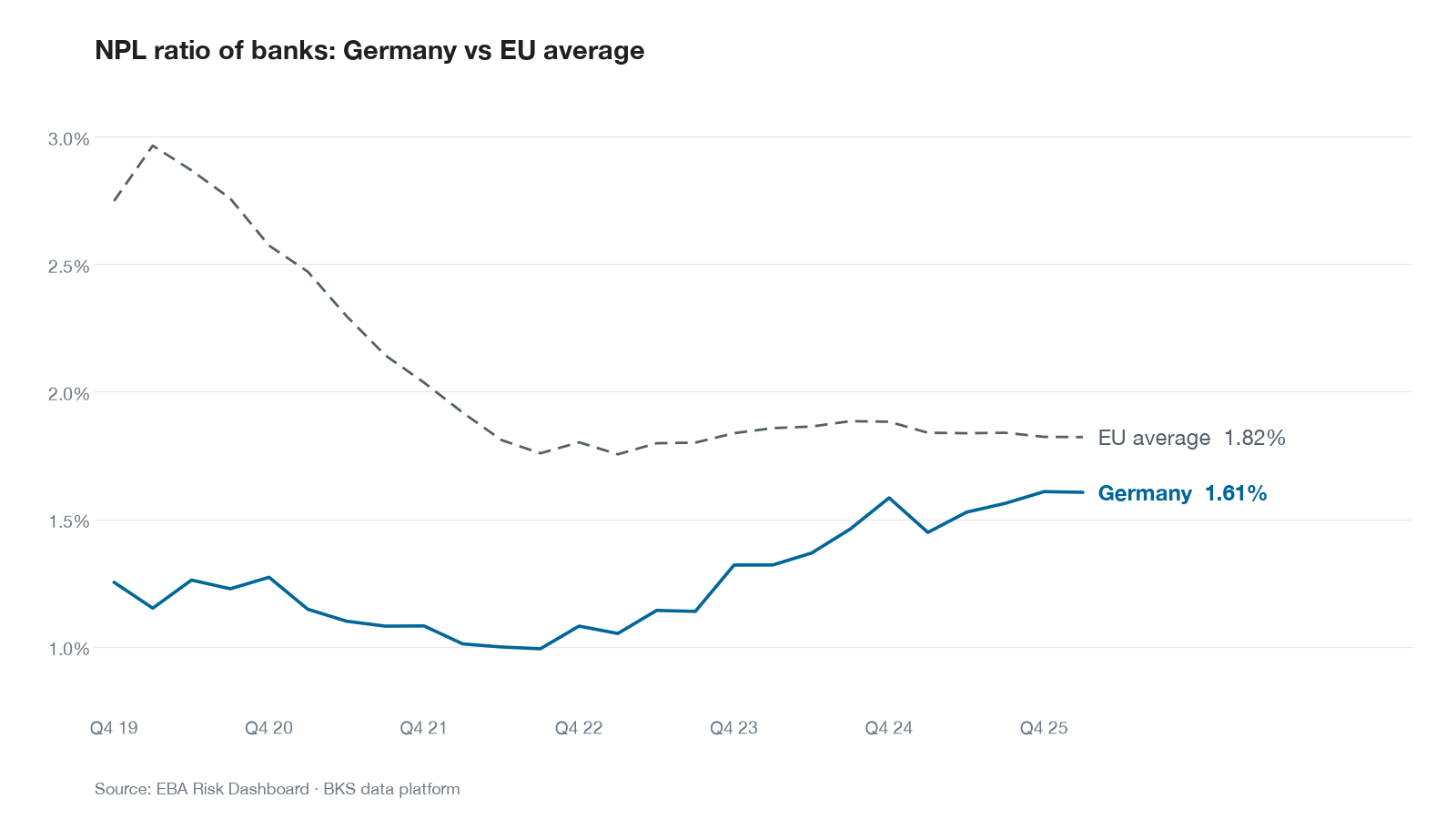
The latest EBA Risk Dashboard (Q4 2025) paints two opposing pictures. Across the EU, the NPL ratio has fallen to a record low of 1.82%, with total volume at €370bn – the lowest since the EBA began collecting the data. A decade of clean-up is paying off: Greece has cut its ratio from over 45% to 2.5%, Italy stands at 2.0% and Spain at 2.5%. The reduction of NPLs in southern Europe is one of the less-noticed success stories of European banking supervision.
In Spain, the secondary market remains active. At the end of March, Sabadell sold its Sibila portfolio – around 100,000 unsecured loans with a face value of €3.1bn – to BKS member Axactor. It is the bank’s largest NPL transaction since the Cerberus deal in 2019. The scale is notable: according to the newspaper Expansión, 80% of portfolio transactions in the Spanish market have for some time been below €500m.
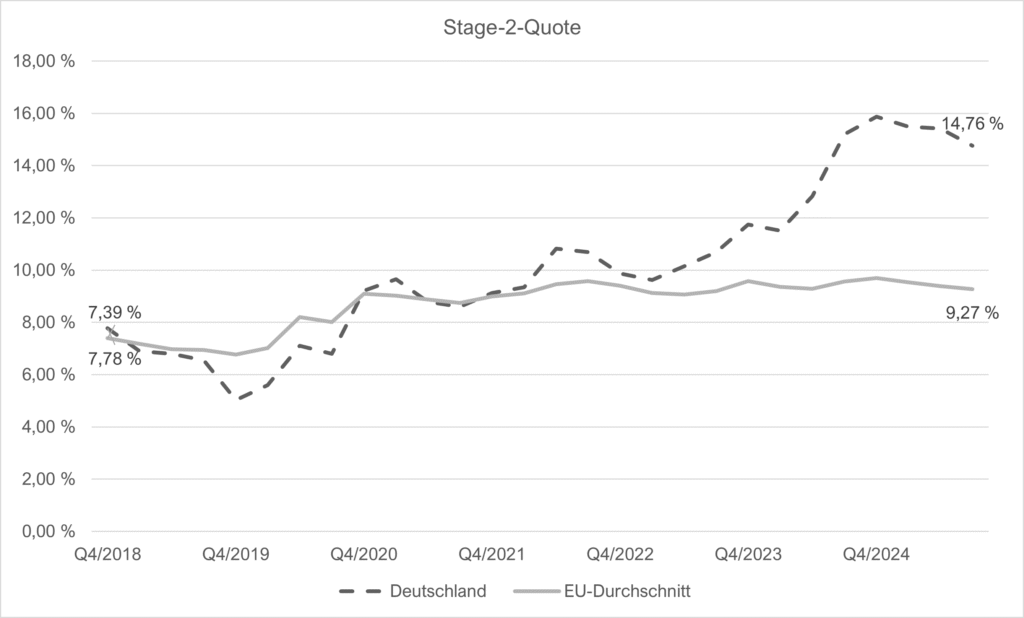
In Germany, the trend runs the other way. The NPL ratio has risen to 1.61% – the highest since 2018 – and NPL volume has reached €48.7bn, a peak in the EBA time series. The drivers: the interest-rate turn, the commercial real estate crisis, and rising insolvencies among mid-sized companies. The stage-2 ratio stands at 15.5%, more than one and a half times the EU average of 9.1%. It has held at this level for over a year, signalling further pressure in the pipeline.
Corporate loans: two-thirds of the problem
The non-financial corporate (NFC) segment remains the most significant problem area: €34.6bn in volume at an NPL ratio of 3.9% – two-thirds of Germany’s entire NPL stock.
Commercial real estate (CRE)
Germany’s CRE NPL ratio now stands at 6.9%, or just under €19bn. The trajectory is striking: in 2019 Germany’s CRE NPL ratio was 1.7%, well below the EU average of 8.6% at the time. Since then the EU has steadily reduced its CRE burden while Germany’s ratio has quadrupled. The lines crossed at the end of 2023. Today Germany sits almost 70% above the EU average of 4.1%. Across Europe, around €58bn in non-performing CRE loans sit on the books – a third of it in Germany.
SME loans
The NPL ratio jumps from 3.9% (Q4 2024) to 4.6% (Q4 2025), with volume at €11.4bn.
Residential mortgages: a new threshold
The NPL ratio on residential mortgages has reached 0.97% for the first time, with volume exceeding €4bn for the first time. The figures are still low in absolute terms, but for the first time in years there is discernible momentum.
Private credit: a new risk for the banking sector?
In parallel, a risk area that has so far sat outside the classic NPL discussion is moving into focus: private credit. The ECB has announced a review of supervised banks’ exposure to the private-credit market. That market has grown to more than €1.5tn – with markedly lighter regulation than the traditional banking sector.
Signs of stress are mounting. Several large funds have recently seen billion-euro redemptions, and ESMA classes the market as a systemic vulnerability. Specialist distressed investors are already positioning for dislocations in the segment. The development matters for the European secondary market because banks help finance the private-credit sector as lenders, counterparties and service providers. The true degree of interconnection is largely opaque. On top of the classic NPL build-up in CRE and SME lending, a new source of risk could open up.
Assessment
The build-up of NPLs in Germany is not a passing phenomenon. Europe’s NPL infrastructure – built during the crisis years – faces a fresh stress test. The pandemic, the war in Ukraine, inflation and the interest-rate turn have compounded over years. Combined with the ongoing recession and a deep industrial crisis, credit quality in Germany has deteriorated structurally – concentrated in CRE and SME loans.
Data and sources
hub.bks-ev.de – the BKS platform is under construction; we welcome feedback and suggestions.
Raw data: EBA Risk Dashboard Q4 2025
Newsletter
Credit Risk Monitor
Market data, policy developments and Alliance news – a few times a year, straight to your inbox.