The business climate in Germany’s NPL market stays at an elevated level, and banks expect non-performing loans to reach €53.1 billion by the end of 2027. The 2026 edition of the NPL Barometer also shows where Germany differs from the European average.
The NPL Barometer has tracked Germany’s market for non-performing loans since 2015. It is compiled by BKS together with Frankfurt School of Finance & Management and is based on a structured survey of risk professionals in German banks, set against supervisory data from the European Banking Authority (EBA). The 2026 edition shows that credit risk at German banks is concentrated in commercial real estate and in lending to small and medium-sized enterprises.
Climate-intensive sectors: a wider gap in Germany than in Europe
A new analysis of banks’ ESG disclosures makes the difference between sectors visible. At the end of 2025, the non-performing ratio in climate-intensive sectors at German institutions was 2.8 percentage points above that of the rest of the corporate loan book. In the EU/EEA aggregate the gap was 0.74 percentage points – roughly a quarter of the German figure.
In the classification used, climate-intensive sectors include real estate activities. They account for around 60% of non-performing exposures in climate-intensive sectors at the seven German institutions whose sector disclosures BKS was able to analyse in detail. Across the pooled exposures of these seven banks, the gap is 3.43 percentage points and thus above the EBA figure for Germany; the two groups of banks differ. The comparison describes how credit risk is distributed across sectors. Its causes have to be assessed against the economic cycle, business models and financing conditions.
“Alongside the economic cycle, there is now a transformation cycle that permanently revalues sectors and devalues collateral that was considered solid for decades,” says Prof. Dr. Christoph Schalast, Chairman of the BKS Advisory Board and Professor at Frankfurt School of Finance & Management.
Climate index unchanged at a high level
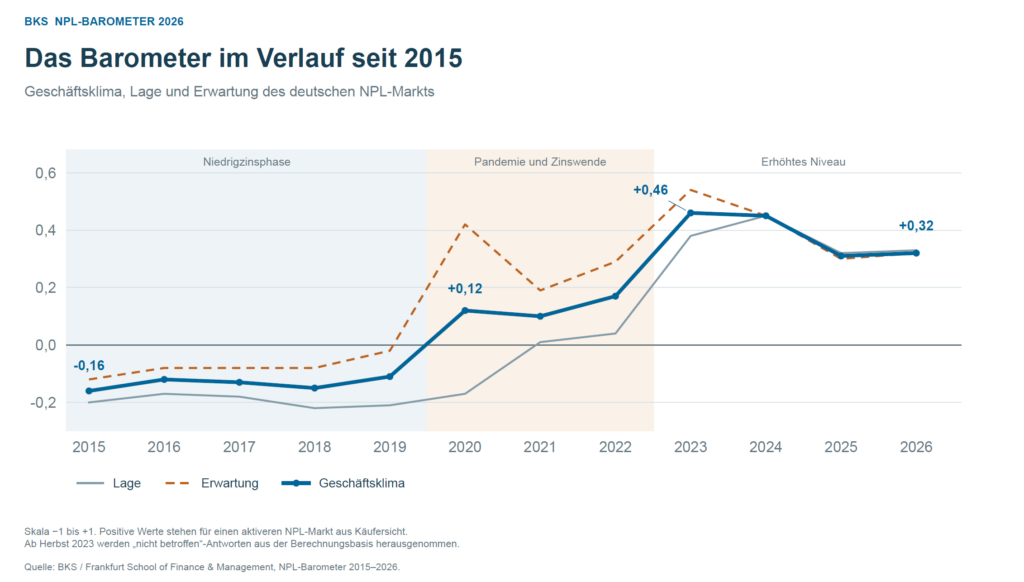
The overall climate index stands at +0.32 in 2026, almost unchanged from +0.31 a year earlier. On the Barometer’s scale from −1 to +1, positive values indicate a more active NPL market from a buyer’s perspective. The series, continued since 2015, traces the path from the low-interest years through the pandemic and the interest-rate turnaround to today’s elevated level: the index was negative in the years after 2015 and peaked at +0.46 in 2023.
NPL stock: panel expects €53.1 billion by the end of 2027
Non-performing loans at German banks rose from €29.7 billion at the end of 2021 to €48.6 billion at the end of 2025. For 30 June 2026, the EBA reports €49.7 billion for its German sample, slightly below the roughly €50 billion reported for the first quarter. The Barometer panel expects €50.4 billion at the end of 2026 and €53.1 billion at the end of 2027.
SMEs and commercial real estate stand out
- SMEs: the panel expects the NPL ratio for loans to small and medium-sized enterprises to rise to 5.1% by the end of 2026 and 5.7% by the end of 2027. The EBA reports 4.5% for the second quarter of 2026.
- Commercial real estate: the panel expects 6.5% at both year-ends. The EBA reports 7.2% for the second quarter of 2026.
The most recent rise in the commercial real estate ratio is mainly a denominator effect. The commercial real estate loan volume reported by the German EBA sample fell by around one eighth in the second quarter of 2026, while the non-performing stock itself declined from €18.3 billion to €17.1 billion. SME lending shows the same pattern.
Stage 2: more loans on watch than in the rest of Europe
Stage 2 loans are loans whose credit risk has increased significantly since initial recognition but which are not yet credit-impaired. As at 30 June 2026 they account for 15.3% of loans at amortised cost in the German EBA sample, compared with 8.9% in the EU/EEA aggregate. Stage 3, by contrast, covers loans that are already impaired: loss events such as defaults or significant financial difficulty of the borrower affect the expected repayments. Possible migrations from Stage 2 to Stage 3 therefore deserve particular attention.
For companies and their financing partners, this puts the early detection of a crisis and the choice of suitable restructuring instruments at the centre, says Martin Kropp, specialist lawyer for banking and capital markets law at the restructuring firm Schultze & Braun. These instruments include pre-insolvency proceedings, the German restructuring framework StaRUG, and cooperation between companies and their lending banks. If signs of a crisis are recognised early, he notes, the chances of overcoming or even avoiding it are good.
Insolvencies: companies and households under pressure
Corporate data complement this outlook. According to the Federal Statistical Office (Destatis), 24,064 corporate insolvencies were recorded in Germany in 2025. CRIF, a provider of credit information, expects up to 26,000 cases in 2026. In the first half of the year, 22.7% of insolvencies were in manufacturing, 13.4% in hospitality, 13.3% in construction and 11.7% in trade including motor vehicle repair – together around 61% of all cases.
According to CRIF’s current classification, 322,890 companies were considered at risk of insolvency in September 2026. That is 10.3% of all companies and 1.4% more than a year earlier. Among the sectors named by CRIF, restaurants (13.2%) and motor vehicle dealers (12.5%) show particularly high shares of companies at risk. Dr. Frank Schlein, Managing Director of CRIF Germany, therefore expects corporate insolvencies to rise again in 2026.
Households are under pressure as well. CRIF recorded 54,900 personal insolvencies in the first half of 2026, 4.5% more than in the same period of the previous year. For the full year it expects 110,000 cases, after just under 108,000 in 2025.
What BKS calls for
“Those who can take legacy burdens off their balance sheets free up capital to support their customers through the transformation,” says BKS President Dr. Marcel Köchling. BKS links the findings to two requests: an evaluation of the German Secondary Credit Market Act (Kreditzweitmarktgesetz), which transposes the EU Credit Servicers Directive, and more transparency on the transaction data supervisors already collect. These data should be made available in aggregated, anonymised form.
Explore the data
The full 2026 edition is freely accessible as an interactive version on the BKS data platform.
About the survey: the panel was surveyed from January to May 2026; the number of usable responses varies by question. Data cut-off for the analysis was 3 September 2026. EBA figures in this article refer to the EBA Risk Dashboard as at 30 June 2026. Quotations are translated from German.
Newsletter
Credit Risk Monitor
Market data, policy developments and Alliance news – a few times a year, straight to your inbox.